Paul Housley

Hunted Projects is delighted to present this interview conducted between London based artist Paul Housley and Steven Cox. The conversation took place in anticipation of Housley's second solo exhibition, Between A Butcher And A Surgeon, at Hunted Projects, Edinburgh, running 26 June - 26 July 2026. The exhibition brings together a new body of paintings built around a single, vivid memory - Psalter Lane Art College emerging through fog on a Sheffield morning in 1985 - and explores memory not as nostalgia but as a living, present process. This interview digs into that process: how a forty-year-old image becomes material for painting, what Housley means by reaching "a state of silence," and how instinct and precision sit against one another in the new work.

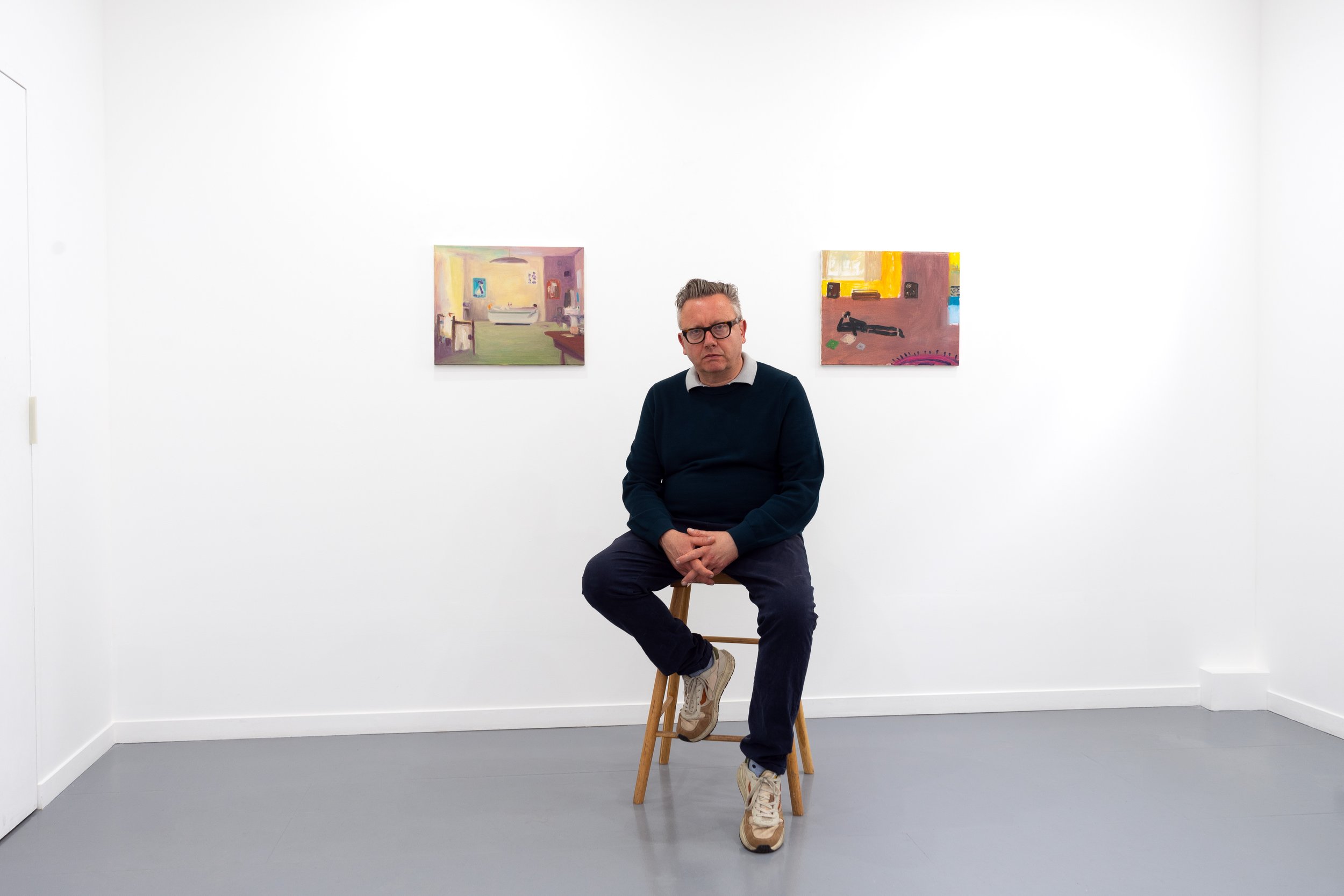
Hunted Projects: The exhibition grows out of one very specific memory - Psalter Lane Art College in the fog, 1985. Why has that particular image stayed with you for so long, and what made now the moment to explore these memories?


Paul Housley: Making the work for the show began in the usual way, in that I was just producing work in the studio, working loosely on an ever ongoing body of work. I knew I wanted the work and the show to become more focused, so when a couple of works began to reference a very particular time from my past I took that chance to home in on one particular time frame. The whole show unfolded quite naturally and quickly from that point onwards.

Hunted Projects: You've said memory for you isn't just a repository of images but a means of entering another state of awareness. Can you talk me through what that state actually feels like when you're painting in the studio?


Paul Housley: The use of memory in my work operates on several levels. I can’t deny nostalgia plays its part but more significantly for me is the use of memory more as “technique” rather than subject. Starting a painting by virtually closing my eyes and trying to remember the details of a very specific moment, the temperature, light, smells and colours of that moment. It’s a way of emptying out my head of all present worries and preoccupations. It’s a strange paradox to think of the past. To enter it now - to be totally in the moment - is the best, maybe only, place to totally make work.

Hunted Projects: This series marks a shift in how you're approaching the canvas. In past bodies of work, you've painted over old surfaces, letting that history build up texture underneath. Here, the canvas is fresh and in places you've even left the grain exposed. What prompted that change?


Paul Housley: I’ve been meaning to make work on fresh surfaces for quite a long time. I’ve had so many old works in the studio that I’ve been methodically reworking so it felt like a real break to work solely on fresh canvas. Like most things in painting the physical realities of the work produce some of the solutions you were looking for.

Hunted Projects: With the surface so much more exposed this time, the paint now has a transparency and sense of vibrancy. There's also less room to bury or rework a mark once it has been laid down. Did that change how you approached memory itself in these paintings - working with a more immediate, less revised version of recollection?


Paul Housley: The fresh surfaces were definitely another element to clarifying the mood and direction of the show. It made the work a little more spontaneous, less revision and less room for mistakes.

Hunted Projects: The exhibition title, Between A Butcher And A Surgeon, could describe the tension in a single mark, but it could just as easily describe you as a painter - someone working both brutally and with real precision. Is that a tension you recognise in yourself, on and off the canvas?


Paul Housley: The title of the show was a phrase I had written down quite some time ago and like most of my titles hint at the paradoxical nature of making art. You have to be smart but somehow  “dumb”, quick but slow etc etc. A work or meaning is never totally one thing, and should somehow contain its opposite.

Hunted Projects: These paintings return you to your BA years in Sheffield. Was it strange revisiting that period so directly, or did it feel more like the memory had been waiting for the right moment to surface?


Paul Housley: My BA years at Sheffield have always been very important to me and I have referenced them before in other work. In the end it just seemed obvious to make this show a concentrated effort to explore those memories in a more focused and structured way.

Hunted Projects: You've spoken about wanting the work to reach "a state of silence" - like a record running out of its groove. How do you know when a painting has actually got there, versus when it's just finished?


Paul Housley: I have an immense love and respect for music. In some ways I see it as the purest form of human expression. I like trying to make painting attain the condition of music, it’s impossible of course- so getting a work to reach a state of silence is my way of paying homage to that aim.

Hunted Projects: Colour tends to carry a lot of the emotional weight in your work. In these paintings specifically, is colour operating as memory itself - pulling you back toward 1985 - or is it doing something more removed from that, working on its own terms?


Paul Housley: The use of colour again operates on several levels. Sometimes it works as a direct “real” reference, true to a memory as it were, but it also helps set the atmosphere and temperature of the work. It’s a bit like tuning in a radio, you are looking for a precise frequency.

Hunted Projects: A few of the titles - Girl In The Library, Student Days, Orpheus Awakes - read like fragments of a longer story. Are these images connected in your mind, or do they each stand alone as separate memories?


Paul Housley: Every work is some a fragment of a larger story. It’s only in doing a show that you can present them in a way that may feel part of a cohesive story.

Hunted Projects: The Pompidou (Memories of Paris) feels like it's pulling in a different geography from the rest of the show. How does that painting sit within the Sheffield-rooted body of work around it?


Paul Housley: The Pompidou painting is slightly the odd one out in the overall theme of the show, but because I decided to hang the show in a kind of chronological order, it operates as a signifier for “the missing years”.

Hunted Projects: All the works in this show share the same intimate scale - 20 x 16 inches. Was that a deliberate decision tied to the idea of memory as something close and contained, rather than monumental?


Paul Housley: The scale of the work was a mixture of practical decisions to do with time and the scale of the space and the desire to present something intimate, which was in step with the nature and subject of the work.

Hunted Projects: You've talked a lot about what happens for you internally while making these - reaching that state of reflection and inner silence. What do you want someone standing in front of the paintings, with none of that context, to actually feel?


Paul Housley: I try not to think of the potential audience when I’m making the work. I don’t want to put any conditions on the work or to have any preconceived notions of how it is to be received. I do however like to feel that my work always operates with empathy and that there is a universal aspect to the themes and ideas that are explored within it.

Hunted Projects: Is there anything from this body of work - a painting, a title, a memory that surfaced during the process - that surprised you, something you didn't expect to find when you started?


Paul Housley: I always hope and aim to surprise myself with my work - that is to continue to learn and explore its limits and where it might be heading. Every work and exhibition is somehow a resonance and possible correction to the last one.


Next
Next

Chuck Webster