Elaine Speirs

Hunted Projects is delighted to present this interview conducted between Edinburgh based artist Elaine Speirs and Steven Cox. The conversation took place in anticipation of Speirs's solo exhibition, Black Pearl, at Hunted Projects, Edinburgh, running 31 July to 13 September 2026. The exhibition brings together a new body of paintings centred on the flower, not as decorative subject, but as a vessel for exploring presence, emotion, and the human condition. At its heart is the exhibition's title work, Black Pearl, the largest and most ambitious canvas Speirs has produced to date.

This interview moves through that process, from the improvisational first marks that begin a painting, to the instinct behind her colour, to the scale and meaning of Black Pearl itself, and the smaller, quieter works that sit alongside it. It also touches on Speirs's long friendship with fellow artist Robert Montgomery, whose accompanying essay for the exhibition, Writing Ophelia's Hands, offers his own reading of the calligraphic line that runs through her work.

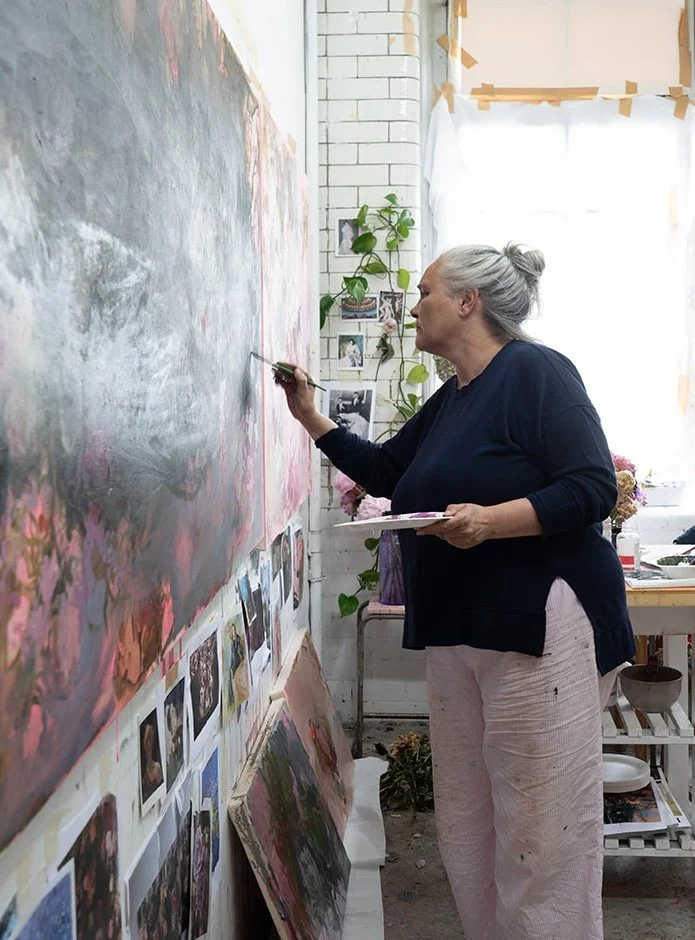
Hunted Projects: Can you walk me through what a typical day in the studio looks like for you, from the moment you arrive, to the moment you know it's time to stop.


Elaine Speirs: I usually arrive at the studio early, after taking my dog for a run in the park. I try to get all my admin done before I start painting, although sometimes it takes me a while to settle into my work. I pace around a lot, thinking about the paintings and where they might go. If I manage to work six hours straight, I consider it a really good day. That's quite rare, so those days feel like little gems. They usually mean something good is happening in the work.

More often, the process is much more complicated. I spend a lot of time researching and thinking before I feel confident enough to begin a painting, or to know how to continue with one. There is a lot of uncertainty in that space between thinking and making, but I have come to understand that it is part of the process too. The pacing, the research, the hesitation and the sudden periods of concentration all belong to the work, and once I achieve this in a day, it's time to go home.

Hunted Projects: This exhibition is entirely devoted to the flower, a subject that places you within one of painting's oldest and most enduring traditions. The flower is one of the most heavily worked subjects in the history of painting, from Dutch still life to Impressionism. What is it about the flower that makes it feel like a subject with no end, one that continues to reveal new possibilities each time you return to it?


Elaine Speirs: The flower's long history in painting is central to my interest in it, but I am equally interested in what remains unresolved within that history. Flowers have been used to signify beauty, morality, desire, femininity, abundance, and loss; they have been arranged as symbols, ornaments and objects of contemplation. I study flowers in gardens, parks, photographs, botanical texts, and art history, moving between direct observation and the accumulated ways flowers have been represented before. I want to understand what I inherit from these traditions, while also testing where their familiar meanings begin to break down.

Hunted Projects: There's a clear improvisational quality to how your paintings come together, the fluorescent base layer, gestural marks, drips, stains, the poetic way the paint settles at its will. Those beautiful initial improvised marks appear to be left untouched in the final composition. But how do your paintings evolve from there? Are you consciously battling to preserve those first moments as the process continues?


Elaine Speirs: Absolutely, it's like a game of roulette always. I think those first moments are incredibly important to me, but I don't consciously try to preserve them. They have a kind of energy and openness that can be very difficult to recreate once you start thinking too much. I'm probably more interested in responding to them than protecting them. From there, the painting becomes a process of looking, researching, and making decisions. I often need to spend a long time with a painting before I understand what it might need. Sometimes I'll make a mark and immediately know it's wrong; other times I'll leave something for a long time and come back to it. There is a lot of adding and wiping away, and sometimes a lot of uncertainty. The challenge is to keep the sense of freedom of the drawing that existed at the beginning while allowing the painting to develop into something more complex. I don't want to tidy up those first marks or explain them too much. They often contain something that happens before I have a chance to think, and I want to keep that feeling.

Hunted Projects: Your colours feel instinctive rather than planned, sweet pinks and golden yellows sitting against intense purples and deep blues. How do you know when a colour is right, beyond simply feeling it?


Elaine Speirs: Colour is instinctive for me, but it isn't completely unconsidered. I know a colour is right when it begins to change the colours around it in a way I want. It's less about choosing a colour in isolation and more about the relationships between them.

I never use pure black. Black feels too final for me, and it can flatten the colours around it. When I need something very dark, I'm usually looking for a colour that has a darkness within, a deep violet, a blue, a brown, something that still has movement to it. I like the idea that the darkest parts of a painting can still hold colour.

I think that's also why the pinks and yellows can sit next to those deeper hues. I'm not thinking, this pink needs to go with this purple. I'm responding to what happens when they meet.

Hunted Projects: Your palette of influences for the painting Black Pearl seem to span two very different sources, Joan Mitchell's gestural abstraction and the composition of Millais's Ophelia. They appear to function differently within this painting, one shaping how you handle paint, the other offering a composition to reinterpret. Is that the right way to understand how each has informed the work?


Elaine Speirs: Yes, I think that's a good way of understanding it. The two painters are doing very different things for me. Joan Mitchell's paintings influence the way I think about paint itself, the gesture, the movement, the physicality, and the sense that a mark can carry emotion without describing anything. I'm very drawn to that freedom.

With 'Ophelia', it was more the composition and the underlying image that interested me. I wasn't trying to reproduce Millais's painting, but I was interested in its composition and meaning, and in seeing what happened when I translated it into my painting.

Hunted Projects: Robert Montgomery's accompanying essay for the exhibition, Writing Ophelia's Hands, describes your painterly line as calligraphic, a kind of writing without words. Do you think of your own mark making as a kind of language, or is that something you leave for others to read into?


Elaine Speirs: This is a lovely question. I like the fact that they remain open to interpretation. Once the mark is on the canvas, it belongs to the painting and the viewer can read it in their own way. The marks come from the physical movement of painting, or rather, drawing with paint. They can be hesitant, emphatic, receptive, or almost like scribbling.

I also like the connection with handwriting. Everyone's handwriting is recognisable, even when we're not trying to make it distinctive. This happens in painting, and over time, our marks become our own handwriting.

Hunted Projects: The central painting of the exhibition, Black Pearl, is your largest and most ambitious painting to date. Did the scale of the canvas force you to rethink your approach to colour, gesture, or the pace of your mark making, and did the process of creating this painting reveal anything new about your approach more broadly?


Elaine Speirs: I think the scale of 'Black Pearl' did change the way I approached the painting. On a larger canvas, everything becomes more physical: the movement of the body, the distance between marks, and the relationship between one gesture and another. I became aware of how to let the painting breathe, rather than trying to fill a space. It also changed the pace of the work. I spent a lot of time thinking and looking, and this painting demanded even more. I would pace around the studio unsure of what the painting needed next. I had to resist the temptation to resolve things too quickly and let the painting develop through a kind of conversation between the marks. Colour became a part of the process too. Rather than thinking of colour as something fixed, I responded to what was happening on the canvas: how one colour altered another, and how a darker area could hold or interrupt a gesture. The scale gave those relationships more room to unfold.

More broadly, I think the painting confirmed something I already knew about my practice: that the work happens as much through uncertainty as through intention. I left the room many times to let things emerge. 'Black Pearl' taught me to trust that process even more.

Hunted Projects: Black Pearl is a beautiful and unusual title, one you've given to both this painting and the exhibition as a whole. Where did it come from, and what meaning does it hold for you?


Elaine Speirs: The title 'Black Pearl' came to me almost as an image before it became a name. There was something about those two words together that felt quietly charged, the darkness of the black against the idea of a pearl, something luminous and precious that has formed slowly, hidden beneath the surface. I like the mystery of a black pearl. It is beautiful, but it also carries something unknown. You can't see the time or the pressure that went into its making, and that feels close to the painting for me.

When 'Black Pearl' became the title of the exhibition as well as the painting, it seemed to hold the body of work together. It became less a description and more of a kind of feeling, a space of darkness, luminosity and perhaps possibilities. For me, the title leaves the door slightly open, which is where I like a painting to exist.

Hunted Projects: Alongside Black Pearl, this exhibition includes much smaller, more intimate works: Lost Grandeur, Rose Garland, and Fallen Peony. What changes for you, moving between a painting built to command a wall and one meant to be held in a much closer, quieter space?


Elaine Speirs: I think the smaller paintings ask for a different kind of attention. 'Black Pearl' has a physical presence; you encounter it with your whole body. The smaller works are much more intimate. They draw you in rather than reaching out towards you.

With a smaller painting, every mark feels more exposed. There is less room for anything to hide, so I become very conscious of the relationship between each brushstroke and the space around it. I work more slowly, and a different kind of concentration is involved. They can feel like fragments or quiet thoughts.

I like moving between these two scales. The large paintings can hold a kind of expansiveness and freedom, while the smaller ones allow for something more intimate and contained. They speak to each other, but they have very different voices.

Hunted Projects: Fallen Peony stands apart as the quietest of the small scale paintings in the exhibition. The canvas, measuring 30cm x 40cm, depicts a single, falling bloom. What was it about this particular flower that invited that much stillness and restraint?


Elaine Speirs: The peony has such an abundance to it, so many layers, so much softness and movement. Once it has passed its moment of fullness, it is still extraordinarily beautiful. There is a kind of vulnerability in that, and I was interested in taking that richness and finding a quieter place within it. Rather than describing the flower, I wanted to suggest it, to let the space around it become part of the painting.

Hunted Projects: In his essay, Robert Montgomery also points to Magenta Rose Petals and Lost Grandeur, paintings where the flower is worked and reworked until only a faint trace of it remains. What draws you to that kind of erasure, letting the subject fade rather than resolving it into a clearer, more finished image?


Elaine Speirs: I don't think of erasure as destroying the painting. It is another form of mark making. What's removed still has a presence of ghostly marks. You can sense something underneath the surface, even when you can no longer see it. I like that tension between presence and absence. With 'Magenta Rose Petals' and 'Lost Grandeur', the flowers become less recognisable. I was interested in what remained after they had been disturbed, covered, reworked and erased. The faint trace of a mark can hold more feeling for me than a fully resolved image. It leaves space for memory and imagination.

Hunted Projects: Your paintings seem to breathe through that contrast, areas left loose and unresolved sitting right alongside sections built up with real conviction. Is that push and pull something you're actively orchestrating as you paint, or does the balance find itself, painting by painting?


Elaine Speirs: I think balance and composition are at the heart of that push and pull. I'm constantly looking at where the weight of the painting is sitting, and at the corners. The corners are so important, and where a mark needs to be stronger, where something needs to recede, and where I need to leave space for the painting to rest. The unresolved areas are just as important to me as the more heavily worked areas. They create a balance. If everything were equally detailed, the painting would become too closed and contrived. I need areas that remain open, where the eye can move in and out of the painting.

Hunted Projects: Your paintings seem to hold a kind of quiet intensity, something that feels personal, even human. What is happening for you internally while you're painting, that might account for that?


Elaine Speirs: I try not to begin with the idea of expressing a particular emotion. It's usually much quieter than that. I'm listening more than I am directing, paying more attention to the painting, to the marks, the spaces between them, and waiting for something to reveal itself. Painting is a very internal experience for me. There are long periods of looking, questioning, making a mark and then living with it before I know whether it's right. I'm often working through uncertainty, and I think that uncertainty is important. It keeps the painting open. My presence in the work comes from the brush marks, the hesitations, the wiping away, and the paint left behind. Every painting carries the journey of its making, and that journey is deeply human.

Hunted Projects: Do you begin a painting with a recognisable flower in mind and abstract it as you work, or does the abstraction come first and the flower emerge from it?


Elaine Speirs: Usually, I begin with a traditional still life setup of flowers, but I am not trying to paint them literally. Observation and intense drawing with the paint are the starting point, which I then begin to disrupt, simplify and abstract as I work. The painting takes over from the original idea, and I'm interested in how far I can move away from the flower while still keeping a sense of its presence.

Hunted Projects: You and Robert Montgomery shared a studio at ECA back in the 1990s, and he still speaks of you as the best painter in your year. There's something rare in having someone who has watched your work unfold over thirty years. How has that long, quiet witness shaped the way you see your own painting now?


Elaine Speirs: It's a lovely thing to have someone who has known my work for a long time. Robert has seen me at so many different stages, including the uncertainty and struggle that inevitably comes with painting, so there's something quite meaningful and beautiful in having that continuity. If anything, it's reassuring to know that someone who knew my work at the very beginning can still recognise something in what I'm doing now. Painting is such an inward and solitary process that it's easy to lose sight of the bigger picture. Having someone who has witnessed that journey over thirty years can remind you that, even when the work changes, and it has changed a lot over thirty years, there are certain things that remain constant.

Hunted Projects: Do you think about the life a painting has after it leaves your studio, the way it might be lived with day to day, and how it could reveal itself differently over years, once it's no longer new to someone?


Elaine Speirs: I do think about that, although I try not to think about it while I'm painting. Once a painting leaves the studio, it has a life of its own, and I like the idea that I no longer control how it is seen or understood. Perhaps that's one of the reasons I'm drawn to paintings that don't reveal everything at once. I hope there's enough ambiguity or space within them for someone to keep discovering something, even years later.

Hunted Projects: Where do you feel this body of work leaves you, and what are you drawn toward next?


Elaine Speirs: I think this body of work leaves me in a place of curiosity rather than certainty. I feel I've understood some things more clearly while making these paintings, but just as many questions have opened up. I want to follow those questions rather than deciding too quickly what comes next. I will keep pushing the questions further, particularly in composition, space, and the ongoing relationship between what is present and what is left unresolved. I am interested in seeing how little I can say while still creating a sense of presence. So I don't really have a fixed destination in mind. Often the most interesting work begins when I stop knowing exactly where I'm going. Scary, but it sometimes works.


Next
Next

Paul Housley